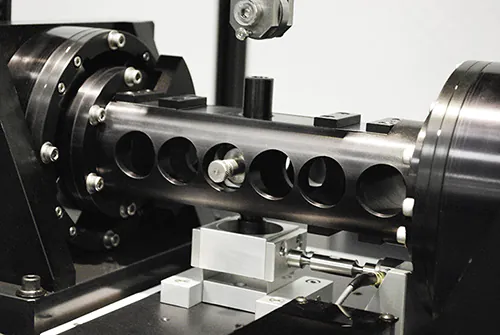
Fretting Test Data and Analysis
Optimize friction, wear, and fretting fatigue evaluations with high-quality data captured at small amplitudes and high frequencies. The MFT-5000’s dedicated fretting module provides researchers and QC engineers with precise micro-motion wear testing, detailed fretting wear evaluation, and powerful analysis tools for confident decision-making across materials and components.
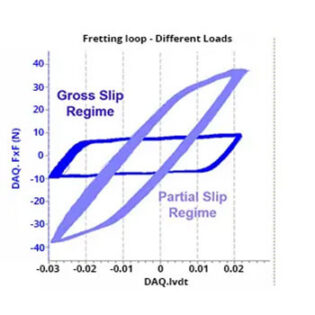
Fretting Loops
Rigid design with accurate real-time friction force allows the measure of fretting loops at different temperatures, and loads.
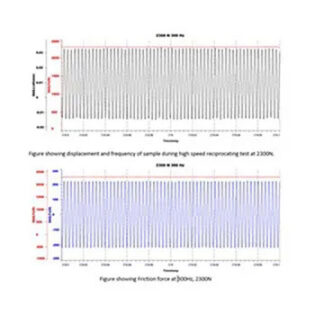
Real Time Friction Curves at 300 Hz
The graph shows real-time friction data at 300 Hz, 2300 N test on dry material fretting
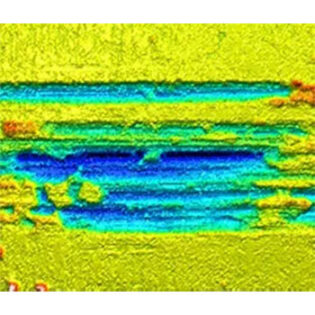
Fretting Failure Marks
Rtec-Instruments’ 3D optical profilometer allows to create 3D images of surfaces with ease.
High-Speed Controllers
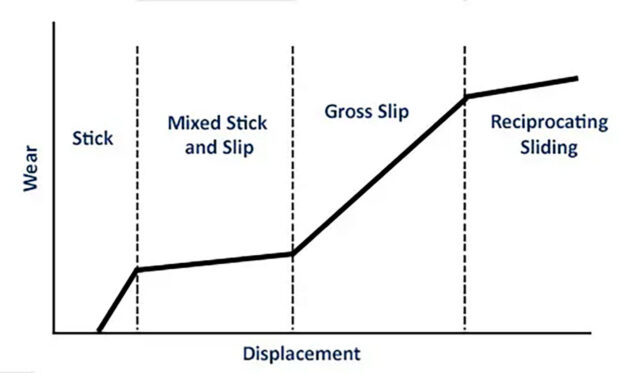
The high-speed control architecture of the MFT-5000 fretting module delivers precise, stable oscillatory motion—ideal for studying surface damage that develops under small-amplitude, high-frequency displacement between contacting surfaces. This capability enables detailed fretting wear testing across a wide range of failure and debris mechanisms.
- Debris formation from asperity contacts
- Oxidation-driven wear influenced by humidity, temperature, or chemical changes
- Lubrication starvation and oil breakdown leading to accelerated wear
- Electrical discharge–induced material removal
- Repetitive micro-collisions between surfaces
- Fatigue-related cracking and early-stage debris generation
- Polymerization of organic materials at the contact
- Highly oxidized fine particulate debris
- Residual steady stage flow of debris
- Diffusive wear processes
- Melting-induced wear at elevated conditions