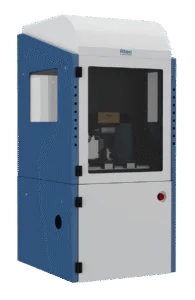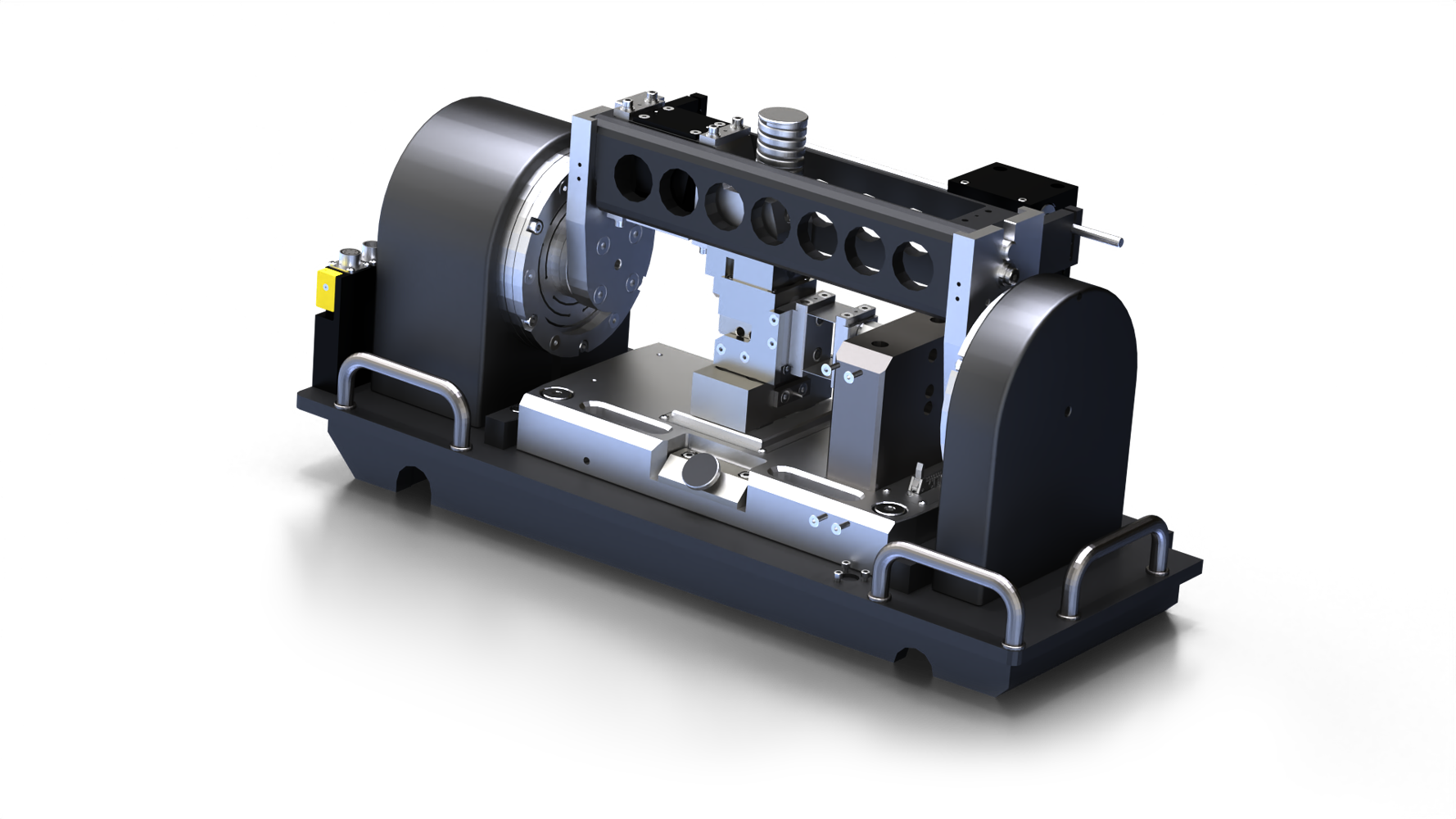
Fretting Voice Coil
The MFT-5000 Fretting & HFRR Module delivers precision fretting wear and lubricity testing from 5 µm micro-fretting to 4 mm macro reciprocating strokes at frequencies up to 300 Hz. Furthermore, flexure-based motion and piezo friction sensors ensure unmatched accuracy for fuel testing, coating evaluation, and advanced tribology research.
More about
The MFT-5000 Fretting & HFRR Module enables precise investigation of fretting wear, friction behavior, and lubricity performance under controlled reciprocating motion. Stroke ranges furthermore extend from 5 µm micro-fretting to 4 mm macro reciprocating wear tests. As a result, the module accurately replicates the full spectrum of real-world contact conditions — from delicate connector interfaces to demanding industrial sliding contacts.
Operating at frequencies up to 300 Hz, the system additionally supports accelerated wear testing and detailed analysis of wear mechanisms and lubricant breakdown behavior. A flexure-based motion architecture furthermore eliminates mechanical backlash, therefore ensuring ultra-stable displacement control critical for high-precision fretting experiments. Combined with high-frequency piezo friction sensors, the module consequently delivers highly accurate real-time friction force signals throughout the test.
Fully integrated into the MFT-5000 modular tribology platform, this module furthermore supports standardized HFRR lubricity testing per ASTM D6079, ISO 12156-1, and CEC F-06 standards. It additionally enables advanced fretting research for fuel systems, coatings qualification, and materials science. As a result, it serves automotive, aerospace, and industrial tribology development applications.
Voice-Coil Actuation with Real-Time Stroke Control
Breakthrough advancements in voice-coil actuation and high-frequency signal processing enable the MFT-5000 to deliver exceptionally stable fretting tests with controlled strokes below 5 microns. This precision furthermore allows researchers to characterize fretting wear across the full range — from micro-scale motion to macro-amplitude conditions. Additionally, combined with ultra-sensitive piezo load cells, a rigid mechanical frame, and low-noise electronics, the system consequently provides quantitative fretting test analysis.
Environmental and Electrical Measurement Options
Humidity, temperature, inert gas, and electrified testing allow for realistic fretting wear simulation.
High Reliability Flexure Design
The flexural suspension guides the magnet assembly without bearings. The magnetic flexure-based design provides the control required for the most sensitive of tests.
The Smallest Controllable Stroke: 5µm to 4mm, Up to 300Hz
Real-time LVDT feedback delivers precise stroke, frequency monitoring, and correction. Optional high-force coils expand the load capacity for demanding applications.
High-Frequency Piezo Force Sensors
Ultra-sensitive piezo friction sensors with low-noise amplification capture rapid force changes during high-frequency reciprocating motion, providing accurate real-time insights into fretting wear and material behavior.
Fretting Test Data and Analysis
Optimize friction, wear, and fretting fatigue evaluations with high-quality data captured at small amplitudes and high frequencies. Furthermore, the MFT-5000’s dedicated fretting module provides researchers and QC engineers with precise micro-motion wear testing and detailed fretting wear evaluation. It additionally delivers powerful analysis tools for confident decision-making across materials and components.
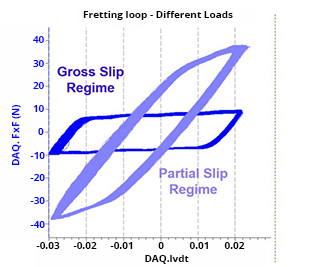
Fretting Loops
Rigid design with accurate real-time friction force allows the measure of fretting loops at different temperatures, and loads.
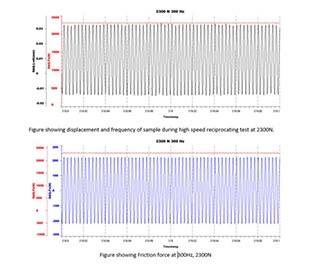
Real Time Friction Curves at 300 Hz
The graph shows real-time friction data at 300 Hz, 2300 N test on dry material fretting test.
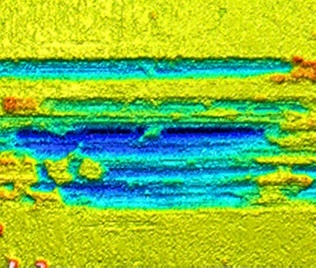
Fretting Failure Marks
Rtec-Instruments’ 3D optical profilometer allows to create 3D images of surfaces with ease.
No technical specifications available.